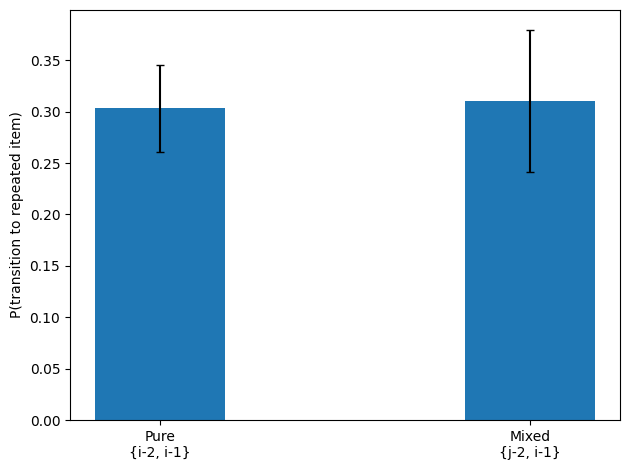
Test whether composite or instance-based retrieval governs repeated-item transitions.
The compound cueing analysis tests a prediction that differentiates composite memory models (CMR) from instance-based models (ICMR). For a repeated item at study positions \(i\) and \(j\) (with sufficient spacing), the analysis examines how the two most recent recalls influence the probability of transitioning to the repeated item.
Pure cueing: last two recalls are \(\{i\!-\!2,\, i\!-\!1\}\) or \(\{j\!-\!2,\, j\!-\!1\}\) (both from one occurrence’s neighborhood)
Mixed cueing: last two recalls are \(\{j\!-\!2,\, i\!-\!1\}\) or \(\{i\!-\!2,\, j\!-\!1\}\) (one from each occurrence’s neighborhood)
CMR (\(\tau = 1\)) predicts mixed cueing provides equal or greater support because similarities sum linearly. ICMR (\(\tau > 1\)) predicts pure cueing provides greater support because sharpening amplifies single-trace matches.