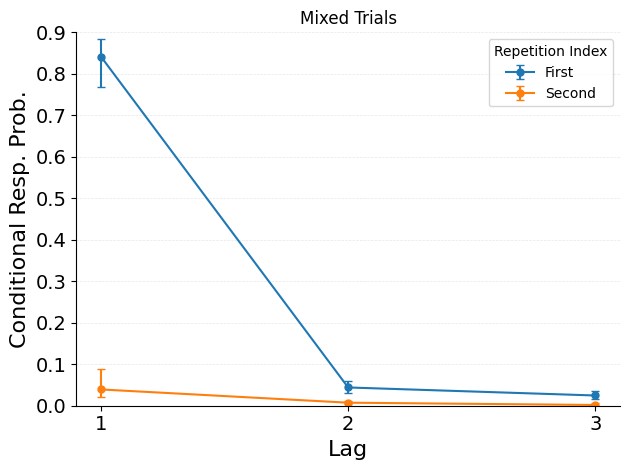
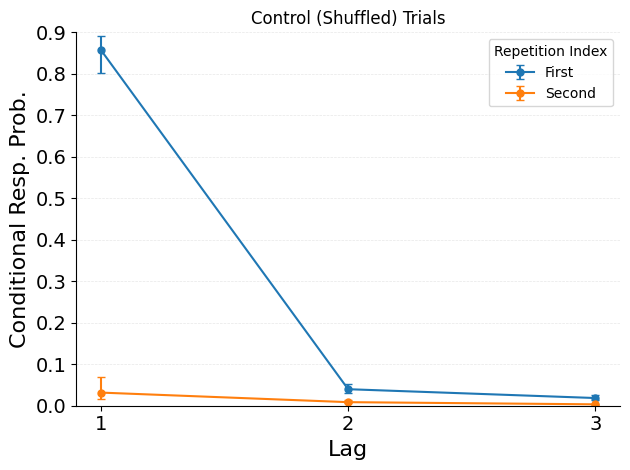
Analyze repetition contiguity conditioned on correctly ordered recall.
The serial repetition CRP conditions on correctly ordered output up to the point of analysis. It tabulates repetition-index CRPs only for transitions where the recall sequence matches study order, stopping once an out-of-order response occurs. This isolates temporal contiguity effects in participants who are maintaining serial order.
============================================================
Statistical Tests: First Presentation
============================================================
  Lag |   t-stat    t p-val |   W-stat    W p-val |  Mean Diff
------+----------------------+----------------------+------------
    1 |   -1.648     0.1167 |     54.0     0.1042 |    -0.0158
    2 |    0.999     0.3309 |     68.0     0.2935 |     0.0042
    3 |    1.192     0.2486 |     66.0     0.2579 |     0.0061

============================================================
Statistical Tests: Second Presentation
============================================================
  Lag |   t-stat    t p-val |   W-stat    W p-val |  Mean Diff
------+----------------------+----------------------+------------
    1 |    1.814     0.0864 |     54.0     0.1042 |     0.0076
    2 |   -0.511     0.6154 |     81.0     0.5949 |    -0.0013
    3 |   -1.390     0.1815 |     25.0     0.0843 |    -0.0015
Interpretation
Plots show repetition CRP curves computed only from correctly ordered recall prefixes. Key patterns:
Stronger contiguity under order: if serial-order maintenance amplifies temporal contiguity, curves will be steeper than unconditioned repetition CRP.
Observed vs. control: differences isolate repetition-specific effects in order-maintaining recall.
First vs. second presentation: reveals which occurrence drives transitions when participants recall in order.
API Details
Notebook parameters
This template uses the same parameter set as the repetition Lag-CRP template. See that template’s API Details for parameter descriptions. Additional parameters:
allow_repeated_recalls — whether the analysis permits repeated recalls.
filter_repeated_recalls — whether to filter out repeated recall events.